
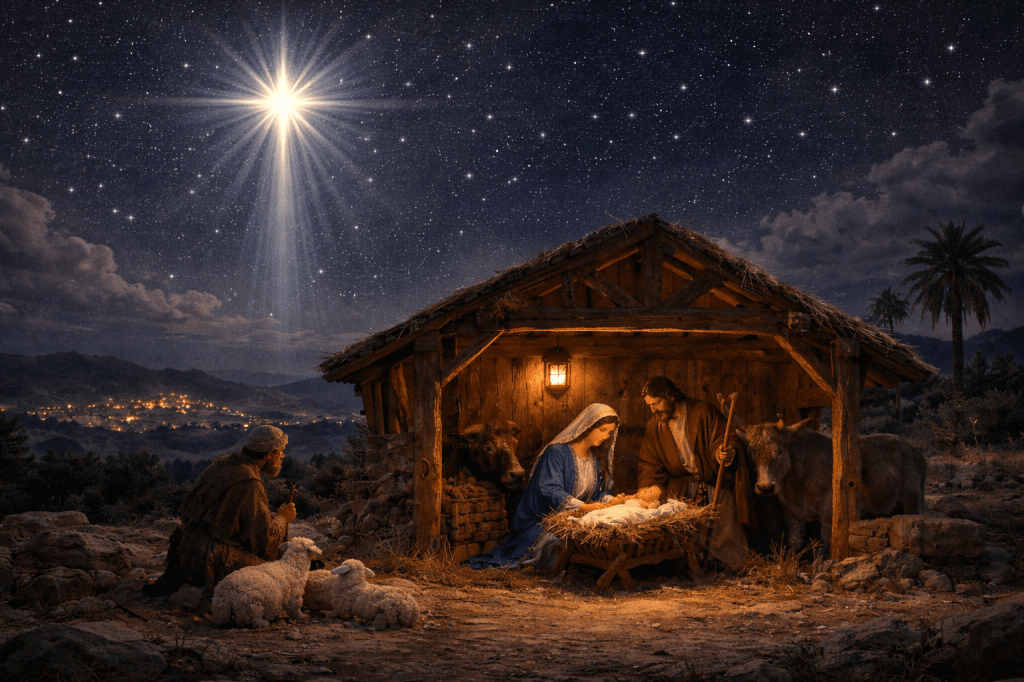
Growing up on Christmas Eve, my family did what so many Italian families do—what generations before us had done, what the old country had taught us to do without ever needing to write it down or explain it in words that could be forgotten. Yes, there was fish, always fish. Baccalà soaking in its milky bath for days beforehand, its sharp scent permeating the kitchen like a promise. Calamari glistening in the pan, tender and golden. Shrimp cocktail arranged on my grandmother’s good crystal, the one she brought over wrapped in newspaper and prayers. Scungilli. Eel for those brave enough. The seven fishes.
The kitchen was a symphony of controlled chaos, laughter rising and falling like waves, voices overlapping in English and Italian and that particular hybrid dialect that belonged only to us, to our corner of the world, to our blood. Clattering plates, the rhythm of wooden spoons against cast iron, the hiss of olive oil meeting garlic, the percussion of tradition passed down not through recipes written on index cards but through watching, through standing beside, through hands guiding smaller hands. My grandmother’s voice calling out instructions. My aunts debating the proper way to prepare something their mothers had made, each insisting their version was the authentic one, the real one, though all of them were real, all of them were true.
The dining room table stretched long, extended with every leaf we owned, covered in my grandmother’s lace tablecloth—the one with the tiny mended spot where my cousin had once spilled red wine, the repair so careful you had to know where to look to find it. Candles flickered. Glasses clinked. Stories were told and retold, polished smooth by repetition until they gleamed like sea glass.
But for all the warmth of that table, for all the abundance and noise and love that filled my grandmother’s home until the walls seemed to breathe with it, the holiness of the night—the place where everything finally came together, where all the preparation and anticipation and longing found its true center—was church.
Every year, without fail, the culmination of Christmas Eve was Mass. Not just attendance, not mere obligation, but culmination. The word matters. Everything led to this. The cooking, the gathering, the lighting of candles, the careful dressing in our best clothes. It was all a procession toward this moment, this threshold, this crossing from the ordinary into the sacred.
Even now, decades later, living a life my younger self could never have imagined, my body remembers it before my mind does. Memory lives in the flesh, in the senses, in places deeper than thought. I can still smell the incense at Assumption Parish, that thick, sweet cloud rising from the thurible as Father swung it in slow, deliberate arcs. The smoke climbed toward the vaulted ceiling, curling and dissipating, prayer made visible, longing given form. It was frankincense and myrrh, the same gifts the Magi brought, the same scents that filled the air around a newborn king in a manger that smelled of animals and hay and the iron-rich scent of birth.
That incense clung to everything—to the heavy velvet of the altar cloth, to the priest’s vestments, to our coats and scarves, to our hair. We carried it home with us, wore it like a blessing, breathed it in our sleep. Even now, catching a whiff of incense in any church, anywhere in the world, I am instantly transported. I am small again. I am held again. I am home.
I can still feel the cool, smooth wood of the pew, worn soft by generations of bodies, of kneeling and sitting and standing, of the faithful and the doubtful and everyone in between. My small hand was wrapped in my Great Aunt Jenny’s steady one, her skin papery and soft, her grip surprisingly strong, her ring loose on her finger, turned inward from years of work. She stood beside me, solid as a lighthouse, gentle as candlelight, saying nothing, saying everything.
Aunt Jenny was not a woman of many words. She had come from the old country as a girl, worked her hands in Maiden Form stitching bras and bathing suits along side her sister. Her faith was not theoretical. It was not something she discussed or debated. It simply was, as fundamental as breathing, as necessary as bread.
In that space, standing beside her, my hand in hers, I felt safe. I felt loved. I felt home in a way that transcended the physical building, though the building mattered too, the stained glass windows depicting saints whose stories I was just beginning to learn, the Stations of the Cross lining the walls, each one a meditation on suffering and love, the statue of Mary with her arms outstretched, her face serene and sorrowful at once.
Church on Christmas Eve was not abstract theology. It was not doctrine to be memorized or arguments to be won. It was belonging. It was beauty. It was the deep, bone-level assurance that God was near, not as an idea, not as a distant force, but as a presence, intimate and immediate, closer than our own breath.
The church was packed, always. Standing room only. Families who came only twice a year—Christmas and Easter—crowded in beside those who attended daily Mass. And it didn’t matter. On this night, we were all the same. All waiting. All hoping. All remembering that once, on a night like this, everything changed.
I can still hear the choir. The echo of voices filling the sanctuary, notes lifting higher than the ceiling, carrying more than sound, carrying memory and hope and grief and joy all tangled together. The organ’s deep bass notes you felt in your chest, in your bones. The soprano voices soaring, almost unbearably beautiful, reaching for something just beyond our grasp.
And there was always one song I waited for with my whole heart, the way children wait for Christmas morning, the way lovers wait for the beloved’s return, the way the earth waits for spring. Tu scendi dalle stelle.
When the first notes began, something in me would still. Would quiet. Would listen with every part of myself.
“Tu scendi dalle stelle, o Re del cielo…”
You come down from the stars, O King of heaven.
The song is gentle, almost tender, not triumphant in the way some Christmas music can be. There is no martial glory in it, no conquering armies, no trumpets announcing victory. Instead, there is intimacy. There is vulnerability. There is the quiet, revolutionary act of divine descent.
It was written in 1754 by Saint Alphonsus Liguori, an Italian bishop and theologian, a man of learning and prayer who wanted people to understand something essential about the Incarnation. Not power. Not glory. Not the distant majesty of an untouchable God. But love. Radical, self-emptying, incomprehensible love.
The carol tells the story of Christ leaving the warmth and radiance of heaven, the place of eternal light, of perfect communion, of unbroken joy, to enter the cold of our world. Born poor in an occupied land, to an unwed mother, in a borrowed stable, wrapped in fragile flesh that could be wounded, that would be wounded, that would bleed and break and die. Choosing humility over splendor. Choosing proximity over safety. Choosing us.
The lyrics linger on the vulnerability of the child, the chill of the night, the quiet sacrifice of divine love. They speak of a baby shivering in the cold, of a God who knows hunger and thirst and weariness. This is not a conquering king arriving with armies and fanfare. This is a God who comes close, who makes himself small, who enters through the narrow gate of human birth with all its mess and pain and beauty.
“E vieni in una grotta al freddo e al gelo…”
And you come to a cave, to cold and frost.
As a child, I may not have known all of that. I couldn’t have articulated the theology of kenosis, of divine self-emptying, of the Word made flesh. But my heart understood. Children often understand what adults have forgotten, what we’ve complicated with too many words, too much analysis. I felt it in the way the melody softened the room, the way even the restless children grew still, the way something holy seemed to settle over us like snow.
I felt it in the stillness that fell over the congregation as voices blended into one, old and young, rich and poor, the devout and the doubting, all of us singing together in a language that was both foreign and deeply familiar, the language of our ancestors, the language of faith. The Italian words rolled off our tongues, some of us fluent, some of us stumbling, but all of us meaning it, all of us reaching for the same mystery.
I felt it in my aunt’s hand tightening just slightly in mine, her thumb brushing across my knuckles, a gesture so small and so enormous, as if to say, Pay attention. This matters. Remember this. Let this shape you.
That song taught me something before I ever had language for it, before I could name it or explain it or defend it in an argument. God meets us in tenderness. God comes down into our lives, into our cold places, into our longing, into the caves where we hide and the darkness where we weep. God chooses proximity over distance, incarnation over abstraction, presence over power.
This is the scandal of Christmas, the thing we can never quite get over if we really let it sink in: God becomes vulnerable. God becomes dependent. God becomes one of us, subject to all the limitations and indignities of flesh—hunger, cold, exhaustion, pain, death. The infinite becomes finite. The eternal enters time. The Creator becomes creature.
And why? The carol answers: for love. Because we were cold, God came to the cold. Because we were lost, God came to find us. Because we could not ascend to heaven, heaven descended to us.
Every Christmas Eve since, no matter where I am or what season of life I am carrying—through years of joy and years of sorrow, through times of certainty and times of doubt, through the bright seasons and the dark ones—that song finds me again. It arrives like a letter from home, like a voice calling my name, like a hand reaching through time to touch my shoulder and remind me who I am, whose I am.
It carries the scent of incense, that thick, sweet smoke that made prayer visible. It carries the warmth of memory, of my aunt’s hand in mine, of my family gathered around a table groaning with abundance, of a church packed with people who came to remember that once, God came close. It carries the echo of safety, of belonging, of being held in something larger than myself, something that began long before I was born and will continue long after I am gone.
It reminds me that faith is not only what we believe, but where we have been held. It is not merely intellectual assent to propositions, not just doctrines memorized or creeds recited. It is the places and people who taught us that love was real, that beauty was possible, that we were not alone. It is my aunt’s hand. It is my mother’s voice. It is the smell of my grandmother’s kitchen. It is the sound of the choir lifting their voices in a language older than any of us.
Faith is embodied. It is particular. It is rooted in specific times and places and people. It is the taste of baccalà on Christmas Eve. It is the feel of cool wood beneath my knees. It is the sight of candlelight flickering on ancient walls. It is the sound of Tu scendi dalle stelle rising like incense toward heaven.
Christmas still arrives for me the same way it did back then, in the same quiet, insistent manner. Not with noise and spectacle, not with the commercial frenzy that tries to claim the season, but in candlelight. In song. In the quiet holiness of a God who comes down from the stars and says, I am here. I am with you. I have not forgotten you. I will never leave you.
Every year, I light candles on Christmas Eve. I play that old carol, sometimes in Italian, sometimes in English, sometimes just humming it to myself in the dark. I remember my aunt, long gone now, her hand in mine. I remember my family gathered around that table, many of them gone too, but somehow still present, still part of the communion of saints that stretches across time and space.
I remember that God comes down. That heaven touches earth. That the infinite becomes intimate. That love makes itself vulnerable. That the King of heaven chooses a cave, chooses cold, chooses us.
And in remembering, I am held again. I am home again. I am that child standing in the pew, hand in hand with my aunt, breathing in incense and wonder, learning without words that I am loved, that I belong, that the God who made the stars cares enough to come down from them, to enter our darkness, to be born among us.
Tu scendi dalle stelle, o Re del cielo.
You come down from the stars, O King of heaven.
And in coming down, you lift us up. In becoming small, you make us large. In entering our poverty, you make us rich. In sharing our mortality, you give us life.
This is the mystery we celebrate. This is the hope we carry. This is the song that finds us, year after year, calling us home to the truth we learned before we had words for it: that God is love, and love comes close, and we are never, ever alone.
Even now, in the quiet of this moment, I can almost smell the incense. I can almost feel my aunt’s hand. I can almost hear the choir beginning, the first notes of that ancient carol rising like prayer, like memory, like hope.
And I am home.
A Christmas Blessing
May the God who descended from stars find you in your cold places this Christmas.
May you know, in the marrow of your bones, that you are not alone, that heaven has bent low to meet you exactly where you are, in all your beautiful, broken humanity.
May you be held the way I was held, by hands that knew suffering and still chose gentleness, by a love that asks nothing but offers everything.
May the incense of memory rise around you like prayer. May the songs of your childhood find you again, carrying the voices of those who taught you that belonging was real, that tenderness was strength, that God was near.
May you feel the cool wood of the pew beneath you, the warmth of a hand in yours, the quiet assurance that you are seen, you are known, you are cherished beyond measure.
May the Christ child—wrapped in poverty, cradled in straw, choosing the cold and the dark to reach you—remind you that holiness is not distant, not abstract, not reserved for the worthy. It is here. It is now. It is for you.
May you taste the feast, hear the laughter, smell the fish and the wine and the sweetness of tradition passed down like sacrament. May you know that every table you gather around echoes the one table where all are welcome, where all are fed, where all are home.
And when the candles flicker low and the carols fade to silence, may you carry this with you into the new year: that you are loved with a love that left heaven, that chose flesh, that will never, ever let you go.
Tu scendi dalle stelle, o Re del cielo.
You come down from the stars, O King of heaven. And in coming down, you meet us here.
Merry Christmas. May you be held. May you be home.
Rev. Allison Burns-LaGreca

 thoughtsprayersandart.com
Leave a comment